This post is pulled from a recent coaching call with my group coaching clients about how body fat actually behaves in the body. I taught them how to look at body fat through three different lenses: health, performance, and aesthetics, and how each perspective changes the conversation.
We talked about the difference between physiology and morality, the role of visceral fat and inflammation, how body fat impacts recovery and performance, and why aesthetics is ultimately about visibility, not worth.
This short clip comes from that conversation, where we were specifically talking about how fat is not an identity, it’s tissue that responds to the environment you create, and how that awareness leads to real empowerment instead of shame.
Body Fat is Not ‘Good’ or ‘Bad’
There are a lot of conversations about body fat on social media that turn into something they were never meant to be: a moral judgment, a personality trait, an identity.
We don’t play like that here.
We keep it practical: how tissue behaves in the body, and what that means for your health, your performance, and your goals.
Because when you strip away the noise, body fat is not “good” or “bad”… it’s tissue. And like muscle tissue, it behaves in specific ways depending on the environment you create.
So let’s look at it through three different lenses: health, aesthetics, and performance.
The Three Perspectives
When you’re talking about body fat, you’re usually talking about one of three things (even if you don’t realize it yet):
- Health: what’s happening internally- inflammation, blood markers, metabolic efficiency.
- Aesthetics: what you can see- definition, visibility of muscle.
- Performance: how your body moves and recovers- energy cost, output, recovery capacity.
None of these perspectives is “more pure” than the other, but they’re not the same conversation and mixing them up is where a lot of confusion (and shame) gets introduced.
So let’s separate them.
Health: Physiology, Not Morality
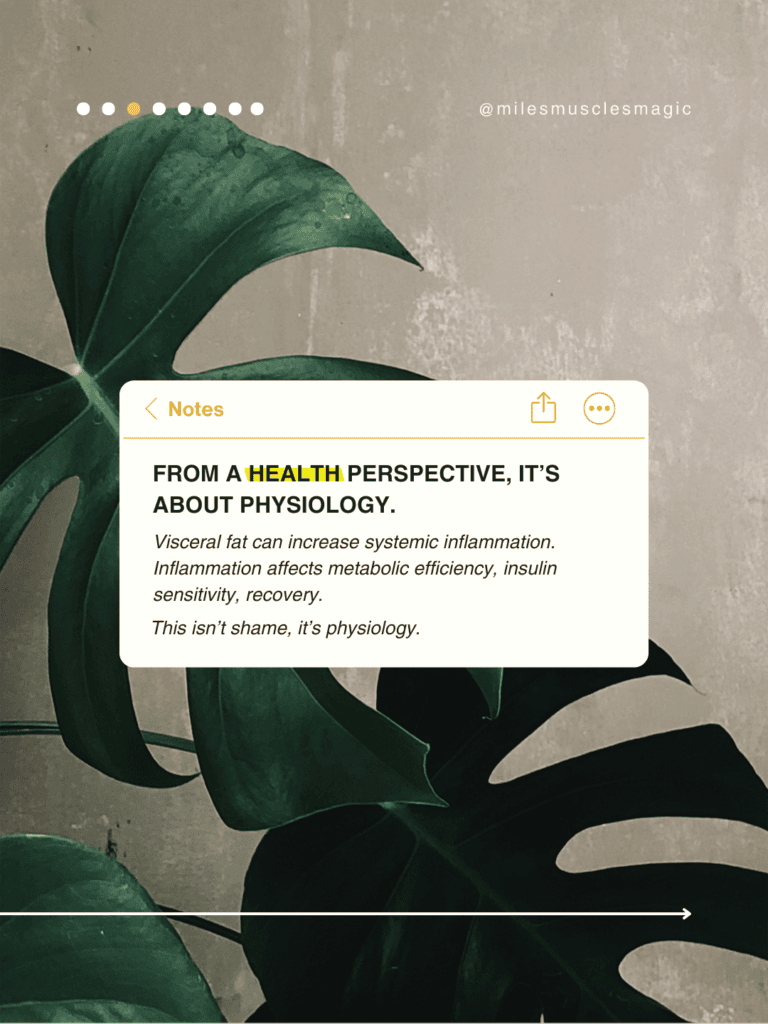
To be clear, this is not about fat as an identity. This is physiology: how your body responds to the environment you give it.
I say this to my SHRED clients often: fat is stored energy…
And also: fat tissue has its own agenda, especially when we’re talking about visceral fat.
There are two basic categories worth knowing here:
- Subcutaneous fat: the fat you can see and pinch.
- Visceral fat: the fat that surrounds internal organs. You can’t pinch it, and you can’t always “see” it, but it’s there, and it’s dangerous in excess amounts.
Why is visceral fat, especially in excess, dangerous?
Because fat tissue releases chemical messengers into the body, these are signals that can increase inflammation. And when fat tissue expands beyond what your body can handle, especially around the organs, those signals can contribute to systemic inflammation.
Systemic inflammation is that low-grade, chronic, background inflammation that doesn’t always feel obvious day-to-day… until it does.
It contributes to things like cardiovascular disease, insulin resistance, diabetes, autoimmune issues. These conditions don’t appear overnight, they build.
Here’s the key point:
When inflammation stays elevated, it can also impact the way your metabolism functions — the way your body uses food and fuel, the way it decides what to use for energy, what to store, and what to use for repair and recovery.
Again: this is not a moral conversation. This is about how the body works.
And it’s also why “health” is a different conversation than “aesthetics.” Because you can’t always see what’s happening internally.
Aesthetics: Visibility, Not Worth
From an aesthetic perspective, body fat is largely about visibility.
If you’ve built muscle, body fat is simply the layer that determines how much of that muscle you can see. More body fat can mean less visible definition, it’s not some crisis
If aesthetics is your priority and you’re not seeing the definition you want, there are usually two possibilities:
- You haven’t built enough muscle yet, or
- You haven’t reduced enough fat to reveal it.
It doesn’t mean you’ve failed, that your body is “wrong” and it doesn’t mean anything about you as a person. It just means your muscle is less visible right now.
Performance: Cost & Recovery Output
From a performance perspective, body fat can influence energy cost and recovery.
More to move = more energy required to move it.
And if you’re moving for a long time, miles, hours, repeated efforts, that cost matters. But this doesn’t mean endurance athletes need to be extremely low body fat! It just means excess body fat can impact performance because it can cost more energy to carry over distance.
There’s also the recovery side. If inflammation is elevated, recovery can suffer, and recovery affects performance across the board (strength training, endurance, sport performance, all of it).
So performance isn’t just about output. It’s about what your body can repeat, sustain, and recover from. Again, this isn’t moral. It’s how the body works.

So… How Much Fat is Too Much?
This is where people want a number. A clean answer, a target, a rule.
But the truth is: how much fat is “too much” depends on what lens you’re using.
- From a health perspective: are your health markers trending in a healthy direction?
- From a performance perspective: are you performing the way you want to perform, and recovering the way you need to recover?
- From an aesthetic perspective: do you like what you see? Do you have visible muscle the way you want?
There is no universal “correct” body fat percentage, there is no arbitrary number, there is no external authority who gets to decide.
This decision is contextual and personal and it should filter through ONE question:
What is your current priority?
- Health?
- Performance?
- Aesthetics?
You get to decide what matters most right now, and how deep you want to go.
Empowerment vs Identity
You are not your fat mass. You are not your muscle mass.
You are only responsible for the environment you’re creating for your body.
That’s it.
Your body responds to the inputs and conditions it’s given over time.
And if you don’t like the way your body is behaving (health-wise, performance-wise, or aesthetic-wise), you get to do something with that information.
Not from shame but from responsibility.
And yes, responsibility comes with accountability. And sometimes that feels heavy, inconvenient and uncomfortable.
But it’s also what makes this whole conversation empowering because when you combine these things (responsibility + accountability + consistency), you’re not just changing your body…
You’re taking your power back.